Woots it was a first for me at St John's Island! Volunteered with RMBR to help out in coastal cleanup together with members of Deutsche Bank(:
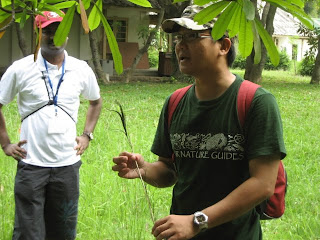
First and foremost, we started with a mangrove tour led by Ron..

Albizia falcataria
The Albizia is a valuable multipurpose plant for the tropics. It is used for pulp and other wood products, fuelwood, ornamental paintings etc. It is highly regarded as a shade tree as well. Albizia is a native plant to this region, but may not be in Singapore. Though it is a very useful tree, it regenerates too easily by natural seeding on any clearing that it may be regarded as a pest.

Sea Hibiscus (Hibiscus tiliaceus)
It can be identified by its distinctive heart-shaped leaves. The plant secretes a sugary substance through a small slit near the stalk of the leaf. Hence sometimes you can see many ants drinking from them when you turnover to the underside of the leaves. The ants, in turn will keep off insect pests hence protecting the plant.

We spotted a dead dried paradise tree snake lying on the grass. They are able to flatten their body and glide from one tree to the other.
Ron was talking about how peacock feather symbolises human courtship(; Male peacocks display their feathers to prospective female mates. The females will then check out the feathers of different male peacocks before making a choice. The length and quantity of male peacock feathers actually indicate his age, vigor and status! Just like how some girls may prefer guys with big cars and houses, the male peacocks with big and heavy feathers conveys the message that they have strong genes and have the resources aha.

The pong pong trees that are commonly seen on our roadside are non-native. They are commonly planted and its flowers are yellow in the centre.
Our native pong pong trees have flowers that are pink at the centre and have elongated fruits(:

Haha of course the journey is not all smooth. We had long walks and even crossed fences. If not this way, how can we see these many different species of plants?(;

We saw many of these volcano-shaped moulds. These are actually made by the mud lobster. They feed on organic particles by digging the sand and mud. Their action help to loosen the mud and allow air and water to penetrate through the soil. These facilitate the growth of mangrove seedling. The moulds also provide shelter for small aquatic creatures during low tides, forming a habitat otherwise known as the 'mud lobster condominum'!

Nipah Palm is a mangrove plant with the oldest known fossil, with pollen dated 70 million years old! Being a very useful plant, its immature fruits (also known as attap chee) are white translucent and hard jelly-like are a common ingredient used in local desserts.

Fig tree (also known as the Bodhi tree)
Although commonly referred as the fruit, the fig fruit is also the flower of the tree, in which the fruits and flowers grow together to form a single mass! The flower is invisible, as it blooms inside the fruit. Warning! Embrace yourselves: Small fig wasps crawl through the opening in search of a suitable place to lay eggs. The flowers provide a safe haven and nourishment for the next generation of wasps. The wasp pollinates the flower with pollen from the fig it grew up in. When the wasp dies, it is broken down by enzymes inside the fig. However fig wasps are not known to transmit any diseases harmful to humans.

These green dopping structures are often mistaken as the leaves of casuarina trees. They are actually casuarina stems that are grooved with tiny scalelike leaves(: Casuarina is a flowering plant as well.
After the mangrove tour, we proceed to our coastal cleanup. The amount of rubbish we collected is no joke!! People just litter their trash carelessly into the sea not knowing the circumstances brought about to our sea creatures. These trash can suffocate our poor marine animals and of course pollute the environment. Fishing nets leftover by fishermen have worse aftereffects! The long stretches of nets can trap all kinds of animals including birds. They all either get roasted under the sun or get drowned during high tides!
It was definitely hard work (looking at their sweat) and a great job done!- a big thank you to the participants!! (:(:
Everyone can do their part to the environment by not littering and better still, pick up rubbish along the way. We can do our part by practising the 3Rs- Reduce, Reuse, Recycle. Small little action like this goes a long way~


After that we had a short tour of the Tropical Marine Science Institute (TMSI). TMSI is a centre of excellence for research, development and consultancy in tropical marine science as well as environmental science. It is quite interesting as we tour around and see how they cultivate the marine animals in nurseries such as the giant clams(as shown in the right picture).
All in all it was a great trip despite the heavy downpour and thunderstorm! My first experience in St John's was good and I definitely want to go back there again, this time exploring the shores(:
References:
 WOA what have we got here that attracted everyone's attention and snapping away with their cameras?
 Sunrise!! Nice~ if only there's dolphins as well q;
 Guided a bunch of enthusiastic happy people today, thanks mudskippers for making this walk such an enjoyable one!
 Peek-a-boo seastar!
 Soft corals- dead man's fingers!
 There were plenty of red seaweed around! Compared to the green seaweeds, they can survive in deeper waters as being red allows them to photosynthesise in lower light levels. //edit (Thanks Ron) The 'nori' used in Japanese sushi is made of certain types of red seaweed. Some red seaweed are also used to make 'agar-agar' in jellies and stabilisers in processed food such as cholocate milk and yogurt.
 Out of so many organisms in Semakau, my favourites are flatworms and nudibranchs (: They come in such vivid colous and patterns! They are poisonous since they feed on sponges and corals. That is where they acquire their toxins from as this is warned to their predators by their bright colours!
 //edit. As we venture further in, we saw a school of fishes! It's best not to approach too close these fishes as we do not know if these fishes have protective mechanism like venomous spines.


 That was a bonus to all of us! We were awed by the displays and that certainly stopped most of my participants in their tracks! The airplanes had captured my participants' attention and boy was I jealous!


 Set off to Semakau again last Sunday (: always love the skies on our way there.
 Nice clouds!~


 As they grow, their body shape become rounder and looks like a cushion!~ More often seen in diving, hence always a TREAT to see them in shores. They have been seen on feeding some species of hard corals and their diet include immobile animals, organic particles found on sand and seaweeds.


 That's a giant giant clam haha.