Thursday, June 11, 2009

Went to Semakau at 4+ am to guide a group of PLMGS girls. There they are posing as our group- upsidedown jellyfish (;


During the walk to the intertidals, we saw an obstructed view of beautiful sunrise!! How often do we get to see this in mainland Singapore? Never in fact, with all the highrise buildings.


Horseshoe crab is spotted by one of our participants (: It is a harmless creature, often seen burrowing quietly into sands feeding on worms, clams and anything edible including dead animals. They may also scrape off algae. Another interesting fact: It needs to exercise in order to eat. It has no jaws. So walking movements grinds up their food, and its bits are then passed on into its four pairs of 'food processing' legs!
Also their blood has a substance that is so sensitive to bacteria that 10% of them died in the process of harvesting to test for the presence of bacteria in human medication. Thank goodness a team from NUS Dept of Zoology has cloned a substance with similar characteristics to replace these wild harvested horseshoe blood.

As they grow, their body shape become rounder and looks like a cushion!~ More often seen in diving, hence always a TREAT to see them in shores. They have been seen on feeding some species of hard corals and their diet include immobile animals, organic particles found on sand and seaweeds.


Upside down jellyfishes passing the 'dead sea zone'..


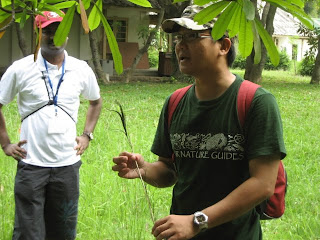
That's hen talking to our participants. Guided together with hen today (:

Juvenile Giant Glam.

That's a giant giant clam haha.
Giant clam feed in both ways. Besides filter feeding for food, the zooxanthelle (symbiotic algae) is also present to make food and provide extra nutrients. They are endangered due to overcollection as a delicacy and making into souveniers like ashtrays.
I always find the way flatworms swim mesmerising. Flatworms are very delicate creatures and should always be handed with care.

A group pic with the star attraction of the day: Knobbly Seastar (: They are one of the biggest seastar we have around.

On the way back, we accidentally intrude the territory of this blue flower swimming crab! It was very agressive waving its claws, ready to declare war with us aha. This is a first sight for me! (:
It is one of the few crabs that are swift and agile due to its last pair of paddle-like feet.


This is sandfish sea cucumber is the haisheng that we eat during chinese new year. It breathes using water that is being flushed in and out through its backend. With this constant flow of water, some tiny creatures find the backside of a seacucumber a cosy and safe place to be! I like how one participant liken it to being in a jacuzzi (;


This black phyllid nudibranch cannot be kept in an aquarium. It release toxic substances when dtressed and this kills the entire tank of fishes!

Very soon it was time for us to leave again as the tides come in. A big thank you to upside down jellyfishes for being such attentive and enthusiastic audiences today!

Do check out other guides' posts:

God's wonderful creation

Wednesday, April 29, 2009


Woots it was a first for me at St John's Island! Volunteered with RMBR to help out in coastal cleanup together with members of Deutsche Bank(:


First and foremost, we started with a mangrove tour led by Ron..

Albizia falcataria

The Albizia is a valuable multipurpose plant for the tropics. It is used for pulp and other wood products, fuelwood, ornamental paintings etc. It is highly regarded as a shade tree as well. Albizia is a native plant to this region, but may not be in Singapore. Though it is a very useful tree, it regenerates too easily by natural seeding on any clearing that it may be regarded as a pest.

Sea Hibiscus (Hibiscus tiliaceus)

It can be identified by its distinctive heart-shaped leaves. The plant secretes a sugary substance through a small slit near the stalk of the leaf. Hence sometimes you can see many ants drinking from them when you turnover to the underside of the leaves. The ants, in turn will keep off insect pests hence protecting the plant.


We spotted a dead dried paradise tree snake lying on the grass. They are able to flatten their body and glide from one tree to the other.


Ron was talking about how peacock feather symbolises human courtship(; Male peacocks display their feathers to prospective female mates. The females will then check out the feathers of different male peacocks before making a choice. The length and quantity of male peacock feathers actually indicate his age, vigor and status! Just like how some girls may prefer guys with big cars and houses, the male peacocks with big and heavy feathers conveys the message that they have strong genes and have the resources aha.


The pong pong trees that are commonly seen on our roadside are non-native. They are commonly planted and its flowers are yellow in the centre.


Our native pong pong trees have flowers that are pink at the centre and have elongated fruits(:


Haha of course the journey is not all smooth. We had long walks and even crossed fences. If not this way, how can we see these many different species of plants?(;


We saw many of these volcano-shaped moulds. These are actually made by the mud lobster. They feed on organic particles by digging the sand and mud. Their action help to loosen the mud and allow air and water to penetrate through the soil. These facilitate the growth of mangrove seedling. The moulds also provide shelter for small aquatic creatures during low tides, forming a habitat otherwise known as the 'mud lobster condominum'!


Nipah Palm is a mangrove plant with the oldest known fossil, with pollen dated 70 million years old! Being a very useful plant, its immature fruits (also known as attap chee) are white translucent and hard jelly-like are a common ingredient used in local desserts.


Fig tree (also known as the Bodhi tree)
Although commonly referred as the fruit, the fig fruit is also the flower of the tree, in which the fruits and flowers grow together to form a single mass! The flower is invisible, as it blooms inside the fruit. Warning! Embrace yourselves: Small fig wasps crawl through the opening in search of a suitable place to lay eggs. The flowers provide a safe haven and nourishment for the next generation of wasps. The wasp pollinates the flower with pollen from the fig it grew up in. When the wasp dies, it is broken down by enzymes inside the fig. However fig wasps are not known to transmit any diseases harmful to humans.

These green dopping structures are often mistaken as the leaves of casuarina trees. They are actually casuarina stems that are grooved with tiny scalelike leaves(: Casuarina is a flowering plant as well.

After the mangrove tour, we proceed to our coastal cleanup. The amount of rubbish we collected is no joke!! People just litter their trash carelessly into the sea not knowing the circumstances brought about to our sea creatures. These trash can suffocate our poor marine animals and of course pollute the environment. Fishing nets leftover by fishermen have worse aftereffects! The long stretches of nets can trap all kinds of animals including birds. They all either get roasted under the sun or get drowned during high tides!


It was definitely hard work (looking at their sweat) and a great job done!- a big thank you to the participants!! (:(:


Everyone can do their part to the environment by not littering and better still, pick up rubbish along the way. We can do our part by practising the 3Rs- Reduce, Reuse, Recycle. Small little action like this goes a long way~


After that we had a short tour of the Tropical Marine Science Institute (TMSI). TMSI is a centre of excellence for research, development and consultancy in tropical marine science as well as environmental science. It is quite interesting as we tour around and see how they cultivate the marine animals in nurseries such as the giant clams(as shown in the right picture).

All in all it was a great trip despite the heavy downpour and thunderstorm! My first experience in St John's was good and I definitely want to go back there again, this time exploring the shores(:


References:


Sunday, March 8, 2009

Semakau! after so long~

Finally get to go Semakau guide agan! With Eunice this time round(:

There was no rain but the weather was a little too hot q: still.. we see many creatures~


Red Swimming Crab (Thalamita spinimana ) can be quite fierce! Swimming crabs are one of the few crabs that are swift and agile swimmers because of their last pair of paddle-like feet. The reason why this carb appears to be 'sandy' is because it has rows of tiny hairs that trap sediments and sand.

//oops this is noble volute's eggs hee. thanks ron!

& we saw 2 nudibranchs!


Lined chromodoris nudibranch (Chromodoris lineolata)


Nudibranchs are known as naked slugs. They have a shell as a young but gradually lose it as it grows older. They are poisonous as advertised by their striking colours and they feed on sponges hence are carnivorous! This particular species feed on blue encrusting sponge (Lamellodysidea herbacea).


Rose nudibranch (Dendrodoris fumata)//thanks samson for ID!
It lacks jaws hence cannot chew on the sponges. Instead it secretes digestive juices into the sponge then sucks up the softened sponge with a long tube! ahah SPONGE SLURPEE?


hmm not too sure what are these transparent like jelly thing is. We saw 3 of it! It's like a jelly and sort of stick to the ground when we try flipping? Perhaps a jellyfish?


Synaptid Sea Cucumber use their feeding tentacles to filter feed for organic particles for consumption. Related to the sea star, they use water as their circulatory system. It is the longest sea cucumber around! People have often mistaken them as worms.


Horseshoe crab! They are 'living fossils" as they have been here days even before dinosaurs are around! Not related to crab, they are more related to spiders and scorpians. Their blood clots easily hence have been sedharvested for medinal use for sometime until NUS cloned a substance to replace it.


ah! thats the new (sea)star they have found recenly at semakau! (:


The sand-sifting stars are practising external fertilisation. Though they lie on top of one another, their sex organ do not actually meet. The sperms and eggs are fertilise externally so this position increase their chances of fertiliation.

A great trip with the giant clam-ers! (thanks Eunice for the group pic!) Thanks everyone for organising and info for the whole trip! Looking forward to the next Semakau trip cause we get to see many different things on each trip(: each trip is a new experience.

sources: wild fact sheets(:

Wednesday, March 4, 2009

MISSES kelong


Enroute to kranji countryside this morning, I saw this jetty. Ahhh this jetty is where I take to my relative's relative's kelong.haha. He owns and sells fishes locally and overseas. Miss everything there! The kids can just drive the boat around freely. bbq in the middle of the sea. no pollution. mussels were aplenty there! & the toilet is the most ultimate hee.
ah when can I go back?

BOTANICS

I just love going out with my parents to gardens in the mornings(;


These leaves so cute. If you notice it 'closes' and droops downwards. hmm not too sure what plant.


Ginger (Zingiber officinale)


The rhizome (whether young, old, fresh, dried or candied) are used to favour food, in cosmetics and medicine. Probably native to India, ginger is grown throughout the tropics.


Turmeric (Curcuma longa)


It is used as a food colouring and flavouring agent and dye. It is an important ingredient of curry powder and traditional cosmetics. Grown widely in tropical ares in Asia, it is the most valuable membr of the ginger family in world trade.


We also saw many other pretty plants(:


Costus lucanusianus (African Spiral Flag)

Hee though manage to find the ID, I didn't manage to find much info about it ><


I find this cute- small young bird nest fern in the middle of the coconut tree.


& on the way back, manage to capture insects hmmm.